Friztian Richard
Rabu, 13 Juni 2012
Minggu, 03 Juni 2012
SMA KESUMA INDAH PADANGSIDIMPUAN membuka pendaftaran penerimaan Siswa Baru
SMA KESUMA INDAH PADANGSIDIMPUAN membuka pendaftaran penerimaan Siswa Baru SEJAK PENGUMUMAN HASIL UJIAN NASIONAL SMP (Sabtu, 02 Juni 2012) di Kantor SMA Kesuma Indah Jl. Batang Gadis, No. 09 Padangsidimpuan, Jam 08.00 s.d. Jam 13.00 WIB setiap hari kerja.
Syarat-syarat pendaftaran, sbb :
a. Membawa tanda bukti lulus berupa SURAT HASIL PENGUMUMAN LULUS atau SKHU
b. Membawa Pas Photo ukuran 3X4 sebanyak 4 lembar
c. Membayar uang pendaftaran Rp. 30.000,-
d. Bersedia membayar Uang Pembangunan Rp. 400.000,- 1 kali selama 3 tahun dan bisa dicicil
e. Bersedia membayar uang sekolah tiap bulannya.
CATATAN : Jumlah Siswa Baru yang akan di terima SANGAT TERBATAS. Maka Pendaftaran akan segera ditutup setelah terpenuhi 2 lokal (80 orang).
SMA KESUMA INDAH....
Yes, Luar Biasa....!!!
Syarat-syarat pendaftaran, sbb :
a. Membawa tanda bukti lulus berupa SURAT HASIL PENGUMUMAN LULUS atau SKHU
b. Membawa Pas Photo ukuran 3X4 sebanyak 4 lembar
c. Membayar uang pendaftaran Rp. 30.000,-
d. Bersedia membayar Uang Pembangunan Rp. 400.000,- 1 kali selama 3 tahun dan bisa dicicil
e. Bersedia membayar uang sekolah tiap bulannya.
CATATAN : Jumlah Siswa Baru yang akan di terima SANGAT TERBATAS. Maka Pendaftaran akan segera ditutup setelah terpenuhi 2 lokal (80 orang).
SMA KESUMA INDAH....
Yes, Luar Biasa....!!!
Sabtu, 02 Juni 2012
Klasifikasi Warna Suara
Kualitas dari bunyi nada biasa disebut dengan pitch.
Nada berbicara beberapa hal antara lain: tinggi rendah, panjang pendek,
dan keras lembut bunyi nada. Bunyi dihasilkan oleh kecepatan getaran
yang sangat kecil pada ketegangan senar, gong, bell, sekelompok udara
yang digetarkan dalam pipa, dan objek yang lainnya. Ketepatan nada
adalah pusat di dalam istilah musik. Jika suara kekurangan ketepatan
nada tersebut, kita tidak akan memiliki melodi atau nada-nada, dan
bahkan sepeda motor dan suara sirine akan menjadi bunyi yang sama.
Dengan kata lain ketepatan nada sangat dibutuhkan guna mengetahui jenis
suara. Begitu juga dengan suara manusia yang memiliki jarak suara yang
normal.
Manusia mempunyai beragam jenis pitch suara, perempuan umumnya memiliki suara yang lebih tinggi dari laki-laki. Umumnya suara manusia dibagi ke dalam empat kategori: Soprano, Alto, Tenor dan Bas (umum juga disingkat SATB). Menurut Alex Paät, pembagian suara manusia yang lebih terperinci adalah:
Ini hanyalah sebuah petunjuk praktis mengenai wilayah suara manusia. Perlu kita ketahui bahwa manusia memiliki wilayah suara yang sangat berbeda, baik suara aslinya ataupun karena telah dikembangkan sedemikian rupa. Penyanyi yang terlatih mungkin masih mampu mengembangkan suaranya di atas atau di bawah wilayah suara yang umum tadi, dan mereka yang tidak terlatih akan memiliki wilayah suara yang sangat terbatas.
Bagian tenor dan bass biasanya selalu dinyanyikan oleh laki-laki, dan bagian yang sopran dinyanyikan oleh perempuan. Bagian sopran juga kadang-kadang bisa dinyanyikan oleh laki-laki yang suaranya belom pecah; misalnya paduan suara gereja dan katedral biasanya menggunakan suara anak laki-laki, meskipun mereka lebih sering disebut trebles daripada soprano. Di beberapa gereja tradisional, bagian alto juga biasa dinyanyikan oleh laki-laki yang memiliki suara tinggi (atau biasanya dengan menggunakan teknik khusus yang dikenal sebagai falsetto).
Warna Suara
Apabila kita mendengarkan flute dan oboe memainkan not yang sama, kita akan dapat membedakan bunyi dari setiap alat musik tersebut. Yang satu akan terdengar lebih terang daripada yang lainnya. Karakteristik bunyi yang membuat kita dapat membedakan setiap bunyi instrument yang satu dengan yang lainnya adalah warna suara atau timbre. Hal yang sama akan kita rasakan juga ketika kita mendengarkan permainan melodi gitar pada gitar klasik atau gitar string, karena memiliki senar yang lebih tipis gitar string akan memiliki warna suara lebih terang daripada gitar klasik. Demikian pula halnya pada suara manusia, bahwa suara manusia juga memiliki perbedaan warna suara. Warna suara tidak sama dengan pitch suara. Seseorang mungkin saja memiliki pitch yang tinggi dengan warna vokal yang gelap. Karena itu kita mungkin sering mendengar orang yang bersuara gelap dapat menyanyikan nada-nada tinggi. Dengan demikian kita dapat membedakan bahwa ada 2 jenis warna suara yaitu terang dan gelap.
Manusia mempunyai beragam jenis pitch suara, perempuan umumnya memiliki suara yang lebih tinggi dari laki-laki. Umumnya suara manusia dibagi ke dalam empat kategori: Soprano, Alto, Tenor dan Bas (umum juga disingkat SATB). Menurut Alex Paät, pembagian suara manusia yang lebih terperinci adalah:
Klasifikasi Suara |
Jarak Umum |
Jarak Tidak Umum |
Jenis Suara |
| Sopran 1 | D – G’ | Bes, – D’ | Kolatura lirik dramatik |
| Sopran 2 | C – E’ | A, – G’ | Mezzosoprano lirik dramatik |
| Alto 1 | Bes, – D’ | G, – F’ | Mezzosoprano lirik kontralto |
| Alto 2 | As, – C’ | F, – Es’ | Kontralto |
| Tenor 1 | D, – Fis | C, – C’ | Lirik Dramatik |
| Tenor 2 | C, – F’ | Bes, – Bes’ | Lirik Dramatik |
| Bas 1 | As,, – D | F,, – F | Bariton |
| Bas 2 | F,, – C | C,, – D | Bas – Bariton |
Ini hanyalah sebuah petunjuk praktis mengenai wilayah suara manusia. Perlu kita ketahui bahwa manusia memiliki wilayah suara yang sangat berbeda, baik suara aslinya ataupun karena telah dikembangkan sedemikian rupa. Penyanyi yang terlatih mungkin masih mampu mengembangkan suaranya di atas atau di bawah wilayah suara yang umum tadi, dan mereka yang tidak terlatih akan memiliki wilayah suara yang sangat terbatas.
Bagian tenor dan bass biasanya selalu dinyanyikan oleh laki-laki, dan bagian yang sopran dinyanyikan oleh perempuan. Bagian sopran juga kadang-kadang bisa dinyanyikan oleh laki-laki yang suaranya belom pecah; misalnya paduan suara gereja dan katedral biasanya menggunakan suara anak laki-laki, meskipun mereka lebih sering disebut trebles daripada soprano. Di beberapa gereja tradisional, bagian alto juga biasa dinyanyikan oleh laki-laki yang memiliki suara tinggi (atau biasanya dengan menggunakan teknik khusus yang dikenal sebagai falsetto).
Warna Suara
Apabila kita mendengarkan flute dan oboe memainkan not yang sama, kita akan dapat membedakan bunyi dari setiap alat musik tersebut. Yang satu akan terdengar lebih terang daripada yang lainnya. Karakteristik bunyi yang membuat kita dapat membedakan setiap bunyi instrument yang satu dengan yang lainnya adalah warna suara atau timbre. Hal yang sama akan kita rasakan juga ketika kita mendengarkan permainan melodi gitar pada gitar klasik atau gitar string, karena memiliki senar yang lebih tipis gitar string akan memiliki warna suara lebih terang daripada gitar klasik. Demikian pula halnya pada suara manusia, bahwa suara manusia juga memiliki perbedaan warna suara. Warna suara tidak sama dengan pitch suara. Seseorang mungkin saja memiliki pitch yang tinggi dengan warna vokal yang gelap. Karena itu kita mungkin sering mendengar orang yang bersuara gelap dapat menyanyikan nada-nada tinggi. Dengan demikian kita dapat membedakan bahwa ada 2 jenis warna suara yaitu terang dan gelap.
Tips Mengiringi Nyanyian Jemaat Agar Dapat Baik
|
Sejarah Music
Music
.| Music | |
|---|---|
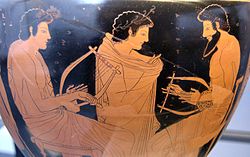
A painting on an Ancient Greek vase depicts a music lesson (c. 510 BC). |
|
| Medium | Sound |
| Originating culture | various |
| Originating era | Paleolithic |
Music is an art form whose medium is sound and silence. Its common elements are pitch (which governs melody and harmony), rhythm (and its associated concepts tempo, meter, and articulation), dynamics, and the sonic qualities of timbre and texture. The word derives from Greek μουσική (mousike; "art of the Muses").[1]
The creation, performance, significance, and even the definition of music
vary according to culture and social context. Music ranges from
strictly organized compositions (and their recreation in performance),
through improvisational music to aleatoric forms. Music can be divided into genres and subgenres,
although the dividing lines and relationships between music genres are
often subtle, sometimes open to individual interpretation, and
occasionally controversial. Within "the arts", music may be classified as a performing art, a fine art, and auditory art. There is also a strong connection between music and mathematics.[2]
To many people in many cultures, music is an important part of their way of life. Ancient Greek and Indian philosophers
defined music as tones ordered horizontally as melodies and vertically
as harmonies. Common sayings such as "the harmony of the spheres" and
"it is music to my ears" point to the notion that music is often ordered
and pleasant to listen to. However, 20th-century composer John Cage thought that any sound can be music, saying, for example, "There is no noise, only sound."[3] Musicologist Jean-Jacques Nattiez
summarizes the relativist, post-modern viewpoint: "The border between
music and noise is always culturally defined—which implies that, even
within a single society, this border does not always pass through the
same place; in short, there is rarely a consensus ... By all accounts
there is no single and intercultural universal concept defining what music might be."[4]
History
Main article: History of music
Prehistoric eras
Main article: Prehistoric music
Prehistoric music can only be theorized based on findings from paleolithic archaeology sites. Flutes
are often discovered, carved from bones in which lateral holes have
been pierced; these are thought to have been blown at one end like the
Japanese shakuhachi. The Divje Babe flute, carved from a cave bear femur, is thought to be at least 40,000 years old. Instruments such as the seven-holed flute and various types of stringed instruments have been recovered from the Indus Valley Civilization archaeological sites.[5] India has one of the oldest musical traditions in the world—references to Indian classical music (marga) are found in the Vedas, ancient scriptures of the Hindu tradition.[6] The earliest and largest collection of prehistoric musical instruments was found in China and dates back to between 7000 and 6600 BC.[7] The Hurrian song, found on clay tablets that date back to approximately 1400 BC, is the oldest surviving notated work of music.
Ancient Egypt
Main article: Music of Egypt
The ancient Egyptians credited one of their gods Thoth with the invention of music, which Osiris
in turn used as part of his effort to civilize the world. The earliest
material and representational evidence of Egyptian musical instruments
dates to the Predynastic period, but the evidence is more securely attested in the Old Kingdom when harps, flutes and double clarinets were played.[8] Percussion instruments, lyres and lutes were added to orchestras by the Middle Kingdom. Cymbals[9] frequently accompanied music and dance, much as they still do in Egypt today. Egyptian folk music, including the traditional Sufi dhikr rituals, are the closest contemporary music genre to ancient Egyptian music, having preserved many of its features, rhythms and instruments.[10][11]
References in the Bible
Main article: History of music in the biblical period
c. 960, Constantinople
Music and theatre scholars studying the history and anthropology of Semitic and early Judeo-Christian culture have discovered common links in theatrical and musical activity between the classical cultures of the Hebrews and those of later Greeks and Romans. The common area of performance is found in a "social phenomenon called litany," a form of prayer consisting of a series of invocations or supplications. The Journal of Religion and Theatre notes that among the earliest forms of litany, "Hebrew litany was accompanied by a rich musical tradition:"[12]
- "While Genesis 4.21 identifies Jubal as the “father of all such as handle the harp and pipe,” the Pentateuch is nearly silent about the practice and instruction of music in the early life of Israel. Then, in I Samuel 10 and the texts that follow, a curious thing happens. “One finds in the biblical text,” writes Alfred Sendrey, “a sudden and unexplained upsurge of large choirs and orchestras, consisting of thoroughly organized and trained musical groups, which would be virtually inconceivable without lengthy, methodical preparation.” This has led some scholars to believe that the prophet Samuel was the patriarch of a school, which taught not only prophets and holy men, but also sacred-rite musicians. This public music school, perhaps the earliest in recorded history, was not restricted to a priestly class—which is how the shepherd boy David appears on the scene as a minstrel to King Saul."[12]
Antiquity
Western cultures
have had a major influence on the development of music. The history of
the music of the Western cultures can be traced back to Ancient Greece
times.
Ancient Greece
Music was an important part of social and cultural life in Ancient Greece. Musicians and singers played a prominent role in Greek theater. Mixed-gender choruses performed for entertainment, celebration, and spiritual ceremonies.[13] Instruments included the double-reed aulos and a plucked string instrument, the lyre, principally the special kind called a kithara. Music
was an important part of education, and boys were taught music starting
at age six. Greek musical literacy created a flowering of music
development. Greek music theory included the Greek musical modes, that eventually became the basis for Western religious and classical music. Later, influences from the Roman Empire, Eastern Europe, and the Byzantine Empire changed Greek music. The Seikilos epitaph is the oldest surviving example of a complete musical composition, including musical notation, from anywhere in the world.
The Middle Ages
The medieval era (476 A.D. to 1400 A.D.) started with the introduction of chanting into Roman Catholic Church
services. Western Music then started becoming more of an art form with
the advances in music notation. The only European Medieval repertory
that survives from before about 800 is the monophonic liturgical plainsong of the Roman Catholic Church, the central tradition of which was called Gregorian chant. Alongside these traditions of sacred and church music there existed a vibrant tradition of secular song. Examples of composers from this period are Léonin, Pérotin and Guillaume de Machaut. From the Renaissance music era, much of the surviving music of 14th century Europe is secular. By the middle of the 15th century, composers and singers used a smooth polyphony for sacred musical compositions. Prominent composers from this era are Guillaume Dufay, Giovanni Pierluigi da Palestrina, Thomas Morley, and Orlande de Lassus.
The Renaissance
Allegory of Music, by Filippino Lippi
Renaissance music (c. 1400 A.D. to 1600 A.D.) was more focused on secular themes. Around 1450, the printing
press was invented, and that helped to disseminate musical styles more
quickly and across a larger area. Thus, music could play an increasingly
important role in daily life. Musicians worked for the church, courts
and towns. Church choirs grew in size, and the church remained an
important patron of music. However, musical activity shifted to the
courts. Kings and princes competed for the finest composers.
visit Friztian
visit my social comunity
Facebook : Friztian Richard
Twiteer : @FrizRichard
Y.M : friz_metalix@yahoo.com
G-Mail : friztianrichard@gmail.com
friztianr@gmail.com
Facebook : Friztian Richard
Twiteer : @FrizRichard
Y.M : friz_metalix@yahoo.com
G-Mail : friztianrichard@gmail.com
friztianr@gmail.com
Langganan:
Komentar (Atom)

